


How to Write a Research Paper for Beginners

Research sounds simple until you actually have to do it. Finding a topic is one thing. Knowing what to search, which sources to trust, how to organise your findings, and what makes an argument worth presenting is another. For students writing their first paper, the process can feel confusing because no one explains what happens between "choose a topic" and "submit the paper."
This research paper writing guide for beginners fills that gap. Whether you want to know how to write a research paper for the first time or how to start a research paper when you're staring at a blank page, you'll find the steps to write a research paper below, along with research paper writing tips and a research paper outline. Think of it as a beginner's guide to academic writing that you can follow from start to finish.
What is a Research Paper?
A research paper is an essay that analyses multiple sources within a field and develops an argument or interpretation from that information. In other words, research means going beyond collecting facts. You examine what different sources say, identify how they connect or differ, and use that information to build your own understanding of the topic.
Purdue University's Online Writing Lab similarly explains that research papers generally require synthesising sources to reach broader conclusions rather than summarising each source one by one. This is the biggest difference between a research paper and a report. A report tells the reader what exists. A research paper tells the reader what it means.
So, for a beginner, the basic idea is: research first, understand the existing information, and then build your paper around what that research tells you. Most academic research follows this same loop of reading, questioning, and reasoning.
How to Write a Research Paper Step by Step?

How to Choose a Research Paper Topic?
A good topic is small enough to handle and big enough to find real sources on. Start with a broad subject that genuinely interests you, because you will spend hours with it. Then do some preliminary reading to see what scholars are already discussing. A quick skim of encyclopedia entries, recent news coverage, or review articles can show you which debates are active and which angles are already crowded.
Once you have a general idea, narrow it down. Purdue OWL suggests narrowing a broad topic by looking at a specific sub-topic, demographic, or time period.
For example, instead of researching "climate change," you could examine its impact on a particular population or within a particular period. "Social media and mental health" is too wide for a ten-page paper. "How Instagram use correlates with sleep quality in teenagers" is something you can actually build an argument around.

A useful way to test your topic is to turn it into a question. Ask "how?" or "why?" rather than settling for a question that can be answered with a simple yes or no. A strong research question should be clear, focused, concise, complex, and arguable. Having a specific research question or thesis gives the writing process direction instead of leaving you with a pile of unrelated information. If you can't find at least five or six credible sources on your question, it's probably too narrow. If you find hundreds that point in different directions, it's probably too broad.
Do Research and Find Credible Sources
Research is where most beginners lose time, so work with a plan. Start with Google Scholar and your university library database, which return academic work rather than random web pages. Prioritise peer-reviewed sources, meaning articles that independent experts in the field have reviewed before publication. Books from academic presses, government reports, and reputable institutional websites also count.
As you read, keep a running document with each source's full details (author, title, date, publisher, page numbers or URL), plus two or three lines on what it says and how it connects to your question. This habit makes citations painless later and helps you avoid accidental plagiarism, which often happens when students lose track of where an idea came from.
Checking the Sources
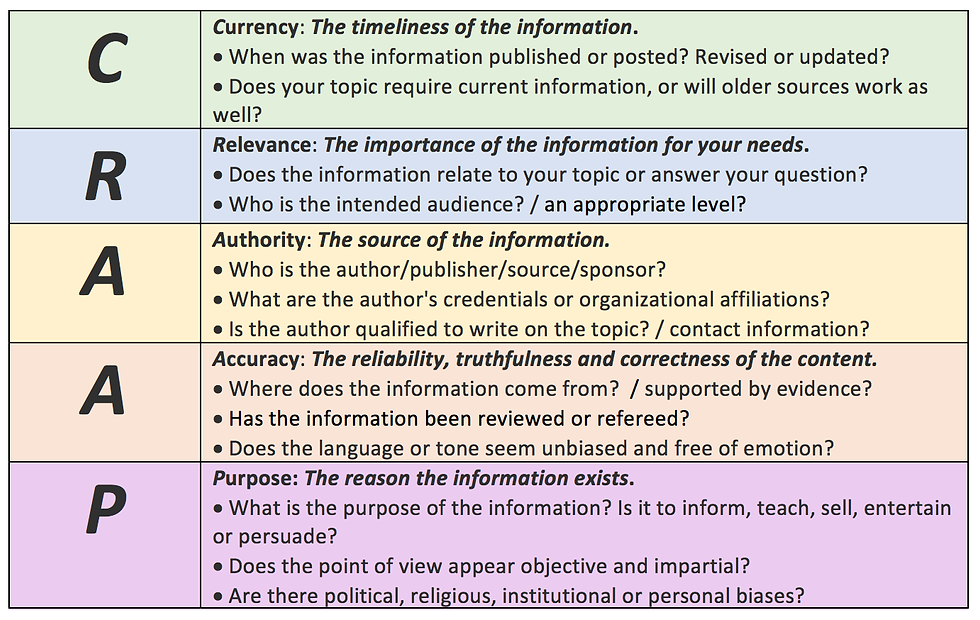
Before any source goes into the paper, run it through something librarians actually use: the CRAAP test. It stands for Currency, Relevance, Authority, Accuracy, and Purpose. Basically: is this recent enough, does it relate to your research question, is the author credible, can the claims be verified elsewhere, and why was the source created (to inform, to sell, to persuade)? A source that fails two or three of those should not be holding up your argument. Check the date first, then the author's credentials, then whether the source cites its own evidence.
How to Write a Literature Review for Beginners?
A literature review is a summary and evaluation of what has already been written on your topic. For a short paper, it may be only a few paragraphs in the introduction or background section. For a longer paper or thesis, it can be its own section. Here is how to approach it as a beginner:
Group sources by theme or argument, not one by one.
Note where scholars agree, where they disagree, and what questions remain unanswered.
End by explaining the gap your paper addresses, which is your reason for writing it.
San José State University has a helpful guide to literature reviews if you want more examples.
How to Write a Thesis Statement for a Research Paper?
Your thesis statement is the central claim of your paper, usually one or two sentences at the end of your introduction. It answers the research question you developed earlier and tells the reader what you will argue and, ideally, how.

A weak thesis states a fact ("Social media affects sleep"). A strong thesis takes a position that someone could reasonably disagree with ("Evening Instagram use reduces sleep quality in teenagers by displacing bedtime routines, suggesting that school-led digital habit programs may be more effective than screen-time limits alone"). Test yours with this question: could a reasonable reader argue the opposite? If not, keep sharpening it. Your thesis may change as you research, and that's normal.
How to Structure a Research Paper?
Before you start writing, create a research paper outline. Knowing how to structure a research paper saves hours of rewriting later. Start with the introduction, where you present the topic and research question, followed by the main body where you organise your research, evidence, and analysis into clear sections. End with a conclusion that brings your findings together and answers the question you set out to explore.
If your paper involves a specific research method, such as surveys, interviews, or experiments, you may also need a separate methodology section. Some papers also require an abstract, a summary of 150 to 250 words that appears before the main text. The exact research paper format varies by subject and university, so treat the outline as a framework rather than a fixed formula. Always check your assignment brief first.
Research Paper Outline TITLE: [Clear, specific title] ABSTRACT: [150-250 words: question, method, key findings, conclusion I. INTRODUCTION A. Hook or opening context B. Background the reader needs C. Research question D. Thesis statement II. LITERATURE REVIEW / BACKGROUND A. What scholars already say B. Where they agree and disagree C. The gap your paper addresses III. METHODOLOGY A. Add how you gathered and analysed the information collected IV. BODY Section 1: [Main point] - Claim - Evidence (source) - Analysis: how this supports your thesis Section 2: [Main point] - Claim - Evidence (source) - Analysis Section 3: [Main point] - Claim - Evidence (source) - Analysis Counter-argument and Response V. CONCLUSION A. Restate the thesis in fresh words B. Summarise key findings C. Why it matters / what future research could explore REFERENCES / BIBLIOGRAPHY
For more sample formats and worked examples, check out these pages:
Purdue OWL: research and citation resources
The Structure of an Academic Paper: strategies for academic paper writing
UNC Writing Center: thesis statements and literature reviews
Writing Centre Resources: writing resources on how to avoid plagiarism, model papers, etc.
How to Write a Research Paper Introduction?
The introduction tells readers what the paper is about and why it matters. Start by introducing the topic, give the context a reader needs, and clearly state your research question and thesis. A common beginner mistake is spending the whole introduction on background. A good test: does your introduction end with a clear point, not just background information? Many writers find it easier to draft the introduction last, once they know exactly what the paper argues.

First Draft of the Research Paper
Once the outline is ready, start writing the first draft without worrying about making every sentence perfect. Focus on getting ideas, evidence, and analysis onto the page, following the structure you already created. If you're stuck on a section, skip it and return later. Momentum matters more than polish at this stage.
Use your sources where they support your points, keep track of the information you use for citations, and make sure each section connects back to your research question. The first draft is meant to give your paper shape. You can refine the language, strengthen your arguments, and fix gaps during editing.
Writing the Body Paragraphs in a Research Paper
Each body paragraph should carry one idea, one piece of evidence, and one sentence connecting that evidence back to your argument. A reliable pattern is claim, evidence, analysis. State your point, support it with a source, then explain in your own words why it matters. Beginners often skip the third part and let quotes speak for themselves, which leaves the reader to guess your reasoning. Use transitions between paragraphs so each one builds on the last.
How to Write a Research Paper Conclusion?
The conclusion brings the main points of your research together and returns to the question introduced at the beginning. It should summarise what the research establishes without introducing completely new arguments or evidence. Restate your thesis in fresh wording, show how your evidence supports it, and explain why the findings matter. You can also suggest what future research might explore. A strong conclusion leaves the reader with a clear takeaway rather than just repeating the introduction.
How Long Should a Research Paper Be?
Length depends on your level and assignment. As a rough guide, a high school paper runs 3 to 5 pages (about 1,000 to 1,500 words), an undergraduate paper runs 8 to 15 pages (2,000 to 4,000 words), and graduate-level work is often 20 pages or more. Your assignment brief always overrules general rules. When you have a page limit, plan your outline around it, giving each main section a rough word count so you don't run out of space for your analysis.
How to Cite Sources in a Research Paper?
A citation is a reference that identifies the source of information, ideas, arguments, or words that you have used. It lets readers trace a claim back to its source and distinguishes your ideas from those taken from other works. Citations are generally given within the text and accompanied by a reference list or bibliography with fuller details of each source. Proper citation is also your main protection against plagiarism, which includes paraphrased ideas, not just copied sentences.
The three styles you will run into most are:
If you are unsure how to format a specific source, AI platforms such as QuillBot can also generate a citation automatically.
Revise and Proofread Your Research Paper

The first draft is a rough compilation of your ideas. The second draft frames them into an actual argument. Start by reading the whole thing straight through without stopping, and mark anywhere the logic or a paragraph feels out of place. Fix the structural issues first: order, missing evidence, weak transitions, and gaps. Only after that should you move to sentence-level fixes like word choice and grammar.
Proofreading is the last pass, focused on typos, punctuation, formatting, and citation details. A useful trick is to read the paper out loud, which catches things your eyes skip every time. You can also change the font, print it, or read it backwards one paragraph at a time. If you can, get a friend or classmate to read it, since fresh eyes spot unclear sentences quickly.
Want to prepare your school or students for MUNs? Connect with us to bring structured training workshops to your institution.
If you have any queries or would like to submit a guest post, contact us or email us at cityoneintitiative@gmail.com. Don't forget to like the blog and share your feedback.


Comments