


What is Oxford Debate?

Debate has long been regarded as one of the most powerful tools for intellectual growth and leadership development. Among the various debating formats practiced worldwide, the Oxford-style debate stands as one of the most prestigious and influential. Renowned for its emphasis on reasoned argument, evidence-based discussion, and persuasive communication, this format has shaped political leaders, scholars, and public intellectuals for over two centuries. If you are wondering how to prepare for an Oxford debate or seeking to master the Oxford debate format, you are in the right place. In this blog, we will cover everything you need to know, from essential Oxford debate rules to actionable strategies on how to win debates.
What is Oxford-Style Debate?

An Oxford-style debate is a highly structured format in which two sides, the Proposition and the Opposition, argue for and against a specific motion. Unlike other competitive formats, the primary objective is to persuade the audience by utilizing logic, evidence, and rhetoric.
The format is famously associated with the Oxford Union, established in 1823. As a global symbol of free speech, the Union has hosted historical figures ranging from heads of state to Nobel laureates. Understanding this history is the first step in mastering the motion and resolution definition that drives every competitive round.
Oxford Debate Format
To compete effectively, you must understand the flow of the session:
The Chairman’s Opening: Introduces the motion and sets the ground rules.
The Proposition Opens: Defines the terms and explains why the current status quo in debating is insufficient.
The Opposition Responds: Challenges the premise and introduces counter-arguments.
Floor Debate: The audience is invited to ask questions and challenge assumptions.
Rebuttals: Both teams summarize their case and dismantle the opposition.
Voting: The audience decides the winner based on the strength of the persuasion.

Essential Tips for Debating
Competitive debating is the art of strategic communication, where victory hinges not just on the strength of your evidence, but on the precision and impact of its presentation. Learning how to improve debate delivery is what turns a good argument into a winning one. In this context, effective public speaking acts as the bridge between raw intelligence and persuasive influence, turning a technically sound case into a truly dominant performance.
Body Language and Delivery
Your non-verbal communication is vital. Use open hand gestures, maintain steady eye contact, and practice your voice projection and vocal tonality in public speaking to emphasize key points. If you experience performance anxiety, remember that managing glossophobia in debates is a skill built through repetition; the more you speak, the more natural you will appear. These are essential, effective public speaking techniques for any orator.
Oxford Style Debate Rebuttal Techniques
Learning Oxford-style debate rebuttal techniques is critical for dismantling the opposition. Use Points of Information (POI) strategically to challenge your opponent during their speech. When you rebut, don't just say they are wrong; explain why their argument fails to address the motion or relies on logical fallacies.
Oxford Debate Opening Speech Tips
The opening speech sets the tone for the entire session. To learn how to write an opening speech:
The Hook: Start with a quote, a startling fact, or a witty observation.
Defining the Motion: Don't leave room for ambiguity; clearly define your stance.
The Roadmap: Preview your key arguments so the audience can track your progress.
Classical Appeals: Use Ethos, Pathos, and Logos to balance credibility, emotion, and logic.
Shashi Tharoor’s Iconic Performance at Oxford Union
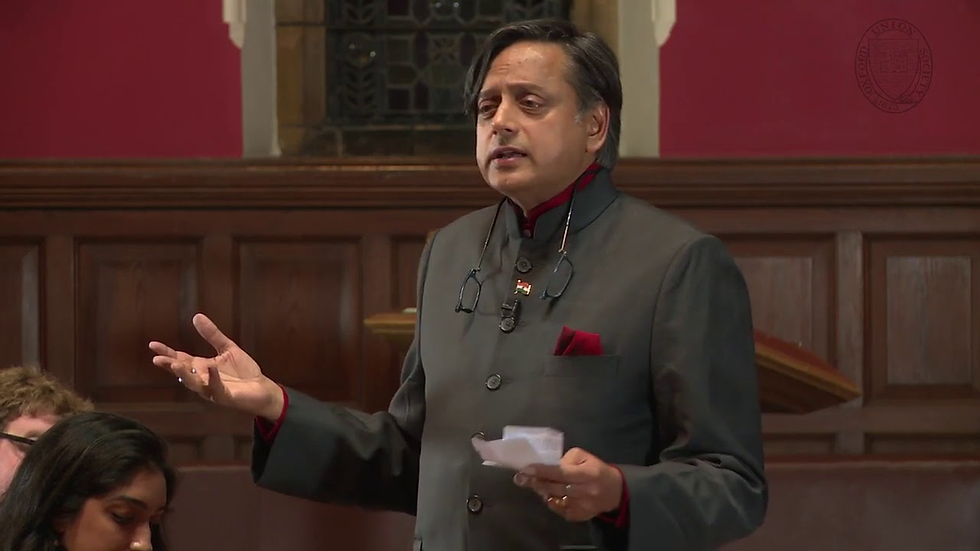
Shashi Tharoor’s 2015 address at the Oxford Union is widely considered a masterclass in oratory because it fundamentally reshaped the discourse surrounding British colonialism. By moving beyond a simple list of historical grievances, Tharoor used a precise combination of irony, economic data, and moral philosophy to dismantle the "benevolent empire" narrative.
What did he speak about?
Tharoor’s central argument was that Britain’s industrial revolution was effectively financed by the systematic "de-industrialization" of India. He provided a compelling case by highlighting several key points:
The Economic Decline: He famously noted that when the British arrived, India’s share of the global economy was roughly 23%; by the time they left, it had plummeted to less than 4%.
The Myth of "Benefits": He challenged the common colonial defense that Britain provided India with infrastructure (like railways) and democracy. He argued that the railways were built primarily to extract raw materials and transport British troops, serving the empire's interests rather than those of the Indian people.
Human Cost: Tharoor detailed the tragic human consequences of colonial policy, specifically pointing to the British-induced famines, most notably the Bengal Famine of 1943, and the massive economic and human toll exacted on India during the World Wars.
Moral Argument: Rather than demanding a specific, calculated financial settlement, he championed the principle of reparations. He proposed a symbolic payment of one pound sterling per year for 200 years, framing it as an act of atonement rather than a commercial transaction.
The Oxford style debate is far more than a competitive exercise; it is a vital training ground for leadership. By mastering the Oxford debate format, refining your public speaking, and learning to navigate the status quo in debating, you equip yourself with the tools to excel in law, politics, and beyond.
Start your journey today, research your motion, prepare your arguments, and let the debate begin!
📌 Want to prepare your school or students for MUNs? Connect with us to bring structured training workshops to your institution.
If you have any queries or would like to submit a guest post, please contact us or email us at cityoneintitiative@gmail.com. Do not forget to like and give your feedback on the blog.


Comments